
Ankle Fusion
Pre Operative Instructions
After your consultation with Dr. Desai, Ana will call you within 24-48 hours to book your surgery.
A few weeks before surgery, you will have a pre-operative visit with Dr. Desai’s team. The purpose of this visit:
Educate you on how to prepare for surgery
Review the post operative course
Providing mandatory devices needed for your surgery
Providing optional devices to help with your recovery
Dr. Desai recommends pre-operative immuno-nutrition to optimize your recovery. This will also be offered at your pre-operative visit:
Day of Surgery
Please refer to: Preparing for Surgery for full details on what to expect the day of surgery.
Right before surgery, you will be taken to the “block room” prior to the operating room. You will get a local nerve block by the anesthesiologist. A nerve block is local anesthetic (freezing) that will be injected around your nerves which freezes your leg. This is done under ultrasound guidance which ensures accuracy and safety. The nerve block avoids requiring a general anesthetic (GA) which requires a full intubation. You will still be given some medication to make you sleepy so you won’t hear, feel or remember anything.
If you prefer not to have a nerve block, or you have had a negative experience with a previous anesthetic, you will be able to discuss this with the Anesthesiologist prior to surgery. They will work with you to address your needs and anesthetic preferences.
The first 24 hours
The first 24 hours after surgery to me is the most important part of your recovery. The nerve block lasts around 12 hours or so. Therefore, in the middle of the night the nerve block will wear off and the pain will start. This is why I recommend starting your pain medications prior to going to bed. By starting your pain medication before the pain starts you have pain medication in your system as the nerve block wears off. This helps block your body’s pain response from ever happening. Nine out of 10 patients who follow these specific instructions have nearly no pain throughout their entire recovery.
You will be getting a prescription for Dilaudid (hydromorphone) which is a narcotic medication. If you have an allergy to this, I will give you a different medication. I recommend taking the Dilaudid before you go to bed. I recommend taking it every six hours. I also recommend taking Tylenol (acetaminophen) and Advil (ibuprofen) together every six hours. I recommend that you stagger these medications. For example, if you go to bed at 9 PM, take your Dilaudid, three hours later at midnight, take Tylenol and Advil, three hours later, take your Dilaudid again, etc:
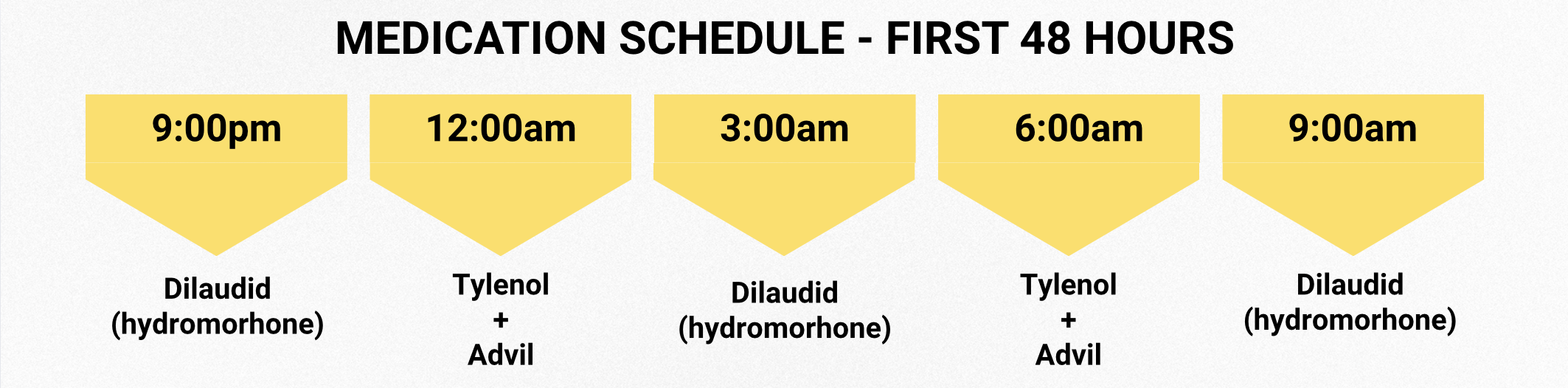
This seems like a lot of medication, but all three medication’s work in very different ways to help manage pain. It is safe to take all three. I want you to have a good experience throughout your entire surgical journey and how do you manage your medication’s directly after surgery is extremely important to making sure you have a good overall recovery.
I would recommend you follow these instructions taking these medications for the first 48 hours only. After the first 48 hours, you can then just take Tylenol and Advil every six hours. Most patients are off all their medications within 2 to 3 days.
I will provide you with more than enough narcotic medication for your surgery. You will most likely not use all the pills provided. I always give a few extra in case. I do not provide refills for narcotics under any circumstance. In the rare circumstance you still have pain after 48 hours, I recommend taking Tylenol and Advil.
First 2 Weeks After Surgery
Pain:
After the first 48 hours you most likely will not require any pain medications. You may need the occasional Tylenol and/or Advil.
Devices:
After surgery you will be placed directly in a walking boot.
Wound/Dressing:
The boot will remain until you see me back in clinic in 2-3 weeks post operatively.
Do not take your boot off any anytime in the first 2-3 weeks.
Do not get your boot wet. Use a bag or cover during your showers.
Weight Bearing:
Non weight bearing for 8 weeks total.
A knee scooter (as opposed to crutches) is highly recommended.
Activity:
Please limit your activity. I would recommend doing your daily activities at home, but I would not recommend any significant activity, long walks, etc. as significant swelling may occur which will be painful and slow your overall recovery.
Light workouts are permitted, but remember, if you work out and sweat your surgical site would sweat as well so keep that in mind.
2 to 8 Weeks After Surgery
Appointment:
At your first post operative appointment (usually 2-3 weeks after surgery) we will remove your dressing and stitches.
Walking Boot: You will be placed back in the walking boot. This should be used at all times. You may remove the boot for showers and icing only. The walking boot functions as a cast. Instead of casting, I prefer the boot so you can remove the boot to take showers.
Game Ready: Game Ready is an optional ice compression machine. A sleeve wraps around your leg and ice water is pumped around your surgically repaired Achilles while simultaneously compressing your lower leg. This helps limit swelling and pain. You may remove your boot and use this 5-6 times per day. Use whatever setting on the machine which you can tolerate.
Wound/Dressing:
We will place small bandages called steri-strips. You may begin taking showers immediately; however, I do not recommend immersing the wound in water (bath, hot tub, pool, etc.) for 6 weeks total from the time of surgery. The steri-strips will slowly peel off themselves. There is no need to pull them off or replace them when they do fall off.
Do not place any creams/lotions etc. for 6 weeks.
Weight bearing:
Non weight bearing for 8 weeks total.
A knee walker (as opposed to crutches) is highly recommended
Activity:
Please limit your activity. I would recommend doing your daily activities at home, but I would not recommend any significant activity, long walks, etc. as significant swelling may occur which will be painful and slow your overall recovery.
You may start exercising (upper body exercises and core exercises)
Therapy:
I recommend you see a therapist starting after the first post operative appointment. I generally recommend a therapist once a week from week 2 to 8 post operatively then 2-3 times per week from week 6 to 12 as this phase is more involved and intense. If you have good insurance coverage, then you can certainly go more often. Humber River Hospital provides their patients with a few free sessions of therapy at the hospital. The therapy protocol is in the black folder given to you on the day of surgery. The protocol is also available here:
8-12 Weeks After Surgery
Appointment:
At 8-week appointment X-rays will be taken to assess healing
Devices:
Walking Boot: You will be placed back in the walking boot. This should be used at all times with walking. You may remove the boot when sitting, sleeping, showering, and doing therapy. Some patients prefer to wear their boot at night for support.
Game Ready: Game Ready is an optional ice compression machine. A sleeve wraps around your leg and ice water is pumped around your surgically repaired Achilles while simultaneously compressing your lower leg. This helps limit swelling and pain. You may remove your boot and use this 5-6 times per day. Use whatever setting on the machine which you can tolerate.
Compression socks: Compression socks are used after surgery in order to decrease swelling. Medical grade compression recommended – 20-30mmHg pressure. Starts between 8-12 weeks post-operatively. Starting at 8 weeks is ideal but some patients feel more comfortable putting the socks on later in their recovery (12 weeks post-operatively).
Weight bearing:
You are permitted to start weight bearing at the 8-week mark after surgery. Your therapist will help with this process.
Activity:
No restrictions in activity
Therapy:
I recommend you see a therapist 2-3 times a week if possible. The therapy protocol is in the black folder given to you on the day of surgery. The protocol is also available here:
12+ Weeks After Surgery
Appointment:
At 12-week appointment X-rays will be taken to assess healing. For most patients, this is the last appointment. For more complex surgeries, I may have you come back one more time at the 6-month mark after surgery.
Devices:
Walking Boot: You may wean off the walking boot. This means you should wear the boot less and less each day (i.e. 16 hours per day, then 14 hours, then 12 hours, etc). In general, you should be out of the boot within 1-2 weeks.
Game Ready: Game Ready is an optional ice compression machine. A sleeve wraps around your leg and ice water is pumped around your surgically repaired Achilles while simultaneously compressing your lower leg. This helps limit swelling and pain. You may remove your boot and use this 5-6 times per day. Use whatever setting on the machine which you can tolerate.
Compression socks: Compression socks are used after surgery in order to decrease swelling. Medical grade compression recommended – 20-30mmHg pressure. Starts between 8-12 weeks post-operatively. Starting at 8 weeks is ideal but some patients feel more comfortable putting the socks on later in their recovery (12 weeks post-operatively).
Weight bearing:
You are permitted to start weight bearing at the 8-week mark after surgery. Once you wean out of the boot you can fully weight bear with your regular shoe.
Activity:
No restrictions in day to day activity.
You may return to all activities, including sports, closer to 6 months post-operatively.
Therapy:
I recommend you see a therapist 2-3 times a week if possible. The therapy protocol is in the black folder given to you on the day of surgery. The protocol is also available here: